Design Your Future: A Strategic Approach to the Personal Growth Planner
As creators, entrepreneurs, and professionals, we often focus our design energy outward—crafting brands for clients, perfecting layouts for readers, or building digital products for customers. We meticulously track client deadlines, content calendars, and production schedules. Yet, when it comes to our own trajectory, we rely on scattered sticky notes or generic, uninspired notebooks. This disconnect is where potential is lost. True professional and personal evolution requires the same intentional design we apply to our work. This is the core philosophy behind the Personal Growth Planner Canva Template. It’s not merely a collection of pages; it’s a structured framework, a premium design asset engineered to bring clarity, direction, and measurable progress to your most important project: yourself.
Architecting Progress: The Anatomy of a Functional Growth System
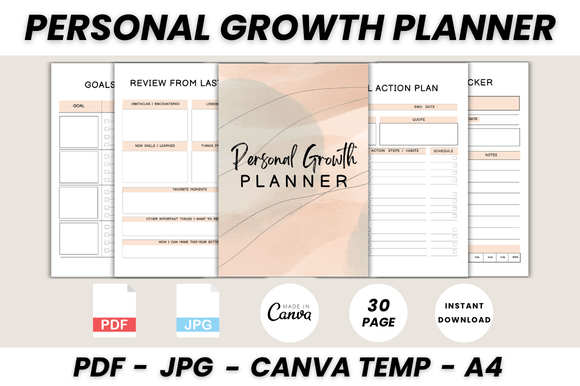
The visual and structural design of a planner directly influences its utility. A cluttered interface creates mental friction, while an overly sparse one can feel devoid of guidance. This template strikes a deliberate balance. Its aesthetic leans into a clean, modern typography sensibility, likely utilizing a harmonious pairing of a clear sans serif font for body text and a more distinctive display font for headers. This isn't just for looks; it's a functional design choice that establishes immediate visual hierarchy, allowing your eye to navigate from a monthly goal overview to a daily action item without confusion. The personality is one of calm professionalism—encouraging without being sentimental, structured without being rigid. The color palette is neutral and adaptable, ensuring it serves as a versatile canvas rather than imposing a specific brand identity onto your personal journey.
The template’s strength lies in its comprehensive, sequential logic. It moves you through a proven cycle of self-assessment, goal setting, execution, and reflection. Consider the flow: It begins with deep-dive pages like Review From Last Year and My Situation Right Now, forcing a honest audit. Then, it guides you to articulate a vision with This Year, I Will Do and Closer To My Ideal Self. This is followed by operational planning through Goal Action Plan pages and granular tools like the Daily Planner and Activities Checklist. Finally, it closes the loop with critical review pages: Goal Reflection and Goal Review. This structure mirrors the workflow of a seasoned brand strategist developing a campaign—it ensures your growth isn't left to chance but is actively managed. The inclusion of specialized pages like Thinking Patterns, Meditation, and Relaxation Tracker acknowledges that sustainable growth integrates mindset and well-being, not just task completion.
Beyond Personal Use: Strategic Applications for Creative Professionals
While its primary function is personal development, the Personal Growth Planner Canva Template offers immense strategic value as a creative font and layout resource for various professional contexts. Its clean, editable nature makes it a fertile ground for adaptation.
- Client Onboarding & Brand Strategy: For designers, marketers, and consultants, repurposing the Goal Action Plan or Review From Last Year pages can create a proprietary onboarding workbook. It helps clients articulate their brand vision, setting a professional tone from the first interaction. The consistent typeface usage across documents reinforces your agency’s brand identity.
- Content Creation & Editorial Design: Bloggers and publishers can use the structured layouts for planning content pillars, editorial calendars, and audience growth strategies. The Ideas Brainstorm and Bucket List pages can be transformed into thematic content maps or reader engagement tools.
- Digital Product Development: Entrepreneurs can study its layout flow to design their own niche planners or journals. Observing how it balances whitespace with utility provides a masterclass in web design and packaging design principles for digital products. The editable files allow for complete customization, making it a foundational design asset.
- Team Management & Social Media Graphics: Adapt the Weekly Planner and To-Do List for team project management. The aesthetic is professional enough for internal use but can be easily styled for sharing progress updates or motivational quotes as social media graphics, using elements from the template to maintain visual consistency.
Practical Guidance: Evaluating Fit and Maximizing Impact
Adopting any new tool requires evaluation. Here’s how to assess and integrate this planner effectively.
Evaluating Project & Personal Fit: Before diving in, define your objective. Are you seeking career clarity, creative skill development, or holistic life balance? Scan the table of contents. Does the sequence of Mindset, Goal Tracker, and Soul Stuff resonate with your approach? The template’s strength is its comprehensiveness, but it should feel like a guide, not a chore. If your focus is purely business metrics, you might primarily use the Goals Overview and Action Plan pages, setting aside others. The power is in the editable files—you can hide or delete pages that don’t serve you in Canva.
Leveraging Font Pairing and Customization: The provided fonts likely work well together, but customization is key to ownership. Use a premium font you’ve licensed for your personal brand to replace the headers, creating a truly unique artifact. Ensure any new script font or handwritten font you add is highly legible for key notes. Test your customized version by printing a single page—does the hierarchy hold on paper? Is the body text at a comfortable readability size? This is where the A4 format shines, offering ample space for handwritten additions.
Beyond the Template: Building a System: This planner is a catalyst, not a cage. Its greatest value emerges when you use it to build a consistent ritual. Schedule a weekly 30-minute session to update your Weekly Planner and reflect using the Goal Review pages. Photograph your completed My Notes sections and store them digitally. Over time, this becomes more than a planner; it becomes a documented record of your evolution, a tangible portfolio of your personal commercial font of growth. By applying the same strategic thinking to your development as you do to a client’s logo design or a marketing campaign, you transform abstract aspirations into a designed reality.